If your last car had a 2.4-liter four or a V6 that just sat there and made power, and your new one has a 1.5-liter with a turbo bolted to it, the maintenance conversation quietly changed on you. Same dipstick, same drain plug, same five quarts, more or less. But the oil going into that engine is doing a harder job than the oil in the car you traded, and the rules about which bottle is acceptable got a lot stricter.
This is not a lecture about changing your oil more often. We already wrote that one. This is about what the hardware itself demands. If you are shopping for an oil change in Washington PA for a newer turbo vehicle, this is the part of the job that separates a real service from a quick drain and fill.
The engine in your driveway probably is one
Turbocharged direct injection stopped being a performance-car thing a while ago. According to Department of Energy figures drawn from the EPA’s 2023 Automotive Trends Report, 73 percent of light-duty vehicles produced for the 2023 model year came with gasoline direct injection, and 37 percent were turbocharged.
Small displacement plus a turbo is simply how manufacturers hit fuel economy targets while still giving you something that merges onto I-70 without drama. So this applies to the commuter crossover that runs I-79 to Pittsburgh every morning, the half-ton parked in a Canonsburg driveway, and the compact your kid drives to class. What you get along with it is an engine that runs hotter, runs at higher cylinder pressures, and asks a lot more of about five quarts of oil.
What a turbo actually does to the oil
A turbocharger is a tiny turbine driven by your exhaust. Nothing on your car spins faster or runs hotter. Turbos reach speeds upward of 300,000 rpm, with exhaust gas on the turbine side running around 1,800 degrees Fahrenheit.
The shaft in the middle of all that rides on a film of your engine oil, which lubricates the bearings and carries heat away from them at the same time.
Which explains a number that surprises most drivers: less than 1 percent of turbo failures trace back to a manufacturing defect, while more than 90 percent are oil related. Turbos rarely just break. They get starved, or they get fed oil that has stopped being oil.
There is a related habit worth breaking. When you shut the engine off, oil flow stops but the heat in the turbine housing does not. It soaks back into the center section and cooks whatever oil is sitting there, and over time that baked residue narrows the passages feeding the bearings. If you have just pulled a long grade with a trailer, or worked the engine hard on Route 19 or the hills out toward Claysville, give it a minute at idle before shutting it down.
Shearing down: why the oil you drain is not the oil you poured in
Modern multigrade oils get much of their behavior from polymer additives called viscosity index improvers. Those polymers are long molecular chains, and in the hot, tightly squeezed places inside an engine they can be physically torn apart. That is called permanent shear, and it is exactly what it sounds like: irreversible.
The industry measures this. High-temperature high-shear viscosity is tested with the oil held under constant shear at 150 degrees Celsius, which mimics what happens in a loaded bearing, and a viscosity improver is rated by its permanent shear stability index. As STLE’s Tribology and Lubrication Technology explains, a viscosity improver with a PSSI of 10 loses 10 percent of its viscosity contribution in service, while one with a PSSI of 50 loses half of it.
Translate that to your driveway. Two bottles can both say 5W-30 on the front. One is still meaningfully a 5W-30 near the end of its service life, and one has quietly thinned out. In a naturally aspirated engine you might get away with the second one. In a turbo engine, the oil film in that 300,000 rpm bearing is the only thing between metal and metal.
The same source notes a benchmark from used-oil analysis: if viscosity at 100 degrees Celsius has dropped more than 10 percent before the drain interval is up, that argues for shortening the interval.
The spec on the cap is a requirement, not a suggestion
Somewhere on your oil filler cap or in the first few pages of your owner’s manual, there is a code. It is not marketing. It is an approval, and your engine was validated on oil that carries it.
GM: dexos1. General Motors announced the third generation of its dexos1 specification in November 2021, tightening the requirements for oxidation resistance, sludge and deposit control, piston and engine cleanliness, turbocharger protection, cold-temperature operation, and low-speed pre-ignition prevention. Gen 3 oils are backward compatible with vehicles that call for Gen 2. Inside the standard, GM replaced the industry Sequence IIIH oxidation test with its own stricter version. A Gen 4 is planned for 2027.
Ford: WSS. Ford’s WSS-M2C961-A1 specification calls for SAE 5W-30 and covers engines including the 2.7-liter EcoBoost V6 in the F-150 and Bronco and the 2.3-liter EcoBoost in the Explorer. The older WSS-M2C948-B is a 5W-20 EcoBoost spec. Two Ford turbos, two different answers, and plenty of both in Washington County driveways.
Volkswagen and Audi: 508 00. The VW Group 508 00 / 509 00 approval is a 0W-20 grade, listed alongside API SP and ACEA C5 performance levels.
Now the trap. A jug on the shelf can say 5W-30 in big letters and still be the wrong oil for your car, because the viscosity grade and the manufacturer approval are two different claims. Matching the number is not the same as matching the spec. This is the most common mistake we see on turbo engines around Washington County, and it usually happens with the best of intentions. If you are not sure what your engine takes, bring the vehicle in or call the shop.
LSPI, and the reason those standards exist at all
There is a specific failure mode behind all this tightening, and it has a name: low-speed pre-ignition, or LSPI.
LSPI is a premature ignition of the main fuel charge, and it shows up predominantly in turbocharged direct-injection engines operating at low speed under high load. Picture pulling away from a light on Jefferson Avenue and giving it a good push in a tall gear. The mixture lights before the spark plug says so, cylinder pressure spikes violently, and you hear knock. At its worst it does catastrophic damage, including cracked pistons.
This is why the oil standards changed. API SP was introduced in May 2020 and ILSAC GF-6 was released the same year, both adding pre-ignition testing for direct-injection engines. GM got there earlier, with LSPI testing in dexos1 Gen 2 back in 2015.
Two notes for reading a bottle. ILSAC GF-6A covers 0W-20, 5W-20, 5W-30 and 10W-30, is backward compatible with older oils, and carries the familiar starburst mark. GF-6B covers thinner grades such as 0W-16, is generally not backward compatible, and carries a newer shield mark. If your engine wants 0W-16, a 0W-20 is not a casual substitute.
Some oil use between changes is normal now
Modern engines use low-tension piston rings. Less ring pressure against the cylinder wall means less friction, which means better fuel economy. It also means a little more oil gets past. Add the turbo, which is fed engine oil by design, and these engines have more paths for oil to leave by than the ones you grew up with.
Some consumption between services is normal. What counts as normal varies by manufacturer, and your owner’s manual states the threshold yours considers acceptable.
What matters is the habit. Park on level ground, shut the engine off, give it a few minutes to drain back, and pull the dipstick. If you have to top up, use oil that meets the same approval, not whatever is in the garage.
This matters more on a turbo four than on an old V6 because of sump size. These engines hold less oil to begin with, so a quart low is a bigger fraction of the total, and the component most sensitive to low oil pressure is the one spinning at 300,000 rpm. If the level keeps dropping and you are also seeing spots on the driveway, that is a different problem, and our guide to what that leak under your car might be is a good place to start.
Carbon on the intake valves: the direct-injection tax
Direct injection sprays fuel straight into the cylinder rather than onto the back of the intake valve. Better atomization, better efficiency, better power. But fuel never washes across the intake valve, and on a port-injected engine that fuel wash is what kept the valve clean.
So residue accumulates. Carbon deposits typically become noticeable somewhere between 25,000 and 50,000 miles. The symptoms are easy to blame on something else: a noticeable loss of performance, a check engine light or an emissions failure, worse fuel economy, and rough running, especially a stumble on a cold start.
That emissions point lands harder in Washington County than it does in a lot of places, since a check engine light is an automatic problem at PA inspection time.
The mechanical fix is walnut blasting. The intake is opened up and crushed walnut shells are blown through the ports under compressed air. The shells are softer than the aluminum and the valve, so they strip the carbon without damaging anything.
You can slow it down, though. Keeping to a sensible oil change schedule and using an oil that meets your engine’s approval means less oil vapor and less varnish reaching the valves in the first place.
Turbo engine auto repair in Washington PA: what we look at when one runs rough
When a turbo direct-injection engine comes into our Washington PA shop running poorly, we work in a fairly predictable order.
- Oil level and condition first. On these engines it is often the answer, or a big part of it.
- Scan tool. Misfire counts by cylinder, knock-related data, and fuel trims. Fuel trims tell us whether the engine is fighting unmetered air.
- The boost path. Charge pipes, clamps, the intercooler and its plumbing. Oily residue inside the piping points toward turbo seals; a loose clamp or split hose points to a boost leak, which feels like a sudden loss of power.
- Sound under load. A light rattle at low rpm under load is a different conversation than a whine or a whistle, and it is the pattern that raises the pre-ignition question.
- Spark plugs. On boosted engines they show up as a misfire under load long before they misbehave at idle.
- Mileage and the intake valves. If everything else looks reasonable and the mileage fits the range where deposits show up, that moves to the top of the list.
Most of the time it is not the turbo. It is something feeding the turbo, or something the oil did or did not do six months ago. That makes it auto repair and maintenance work rather than a parts swap, and it helps to know the warning signs that call for a mechanic instead of a wait-and-see.
How often? That’s a different post
We have not given you a mileage number anywhere in this article, and that is deliberate. Intervals depend on how and where you drive, and we covered that ground in detail in our Washington, PA driver’s guide to oil change intervals.
This post is about the hardware. What the turbo and the direct injection themselves require, regardless of your schedule: the right approval, a healthy oil level, and an oil that is still doing its job at the end of its life rather than only at the beginning.
Come see us in Washington, PA
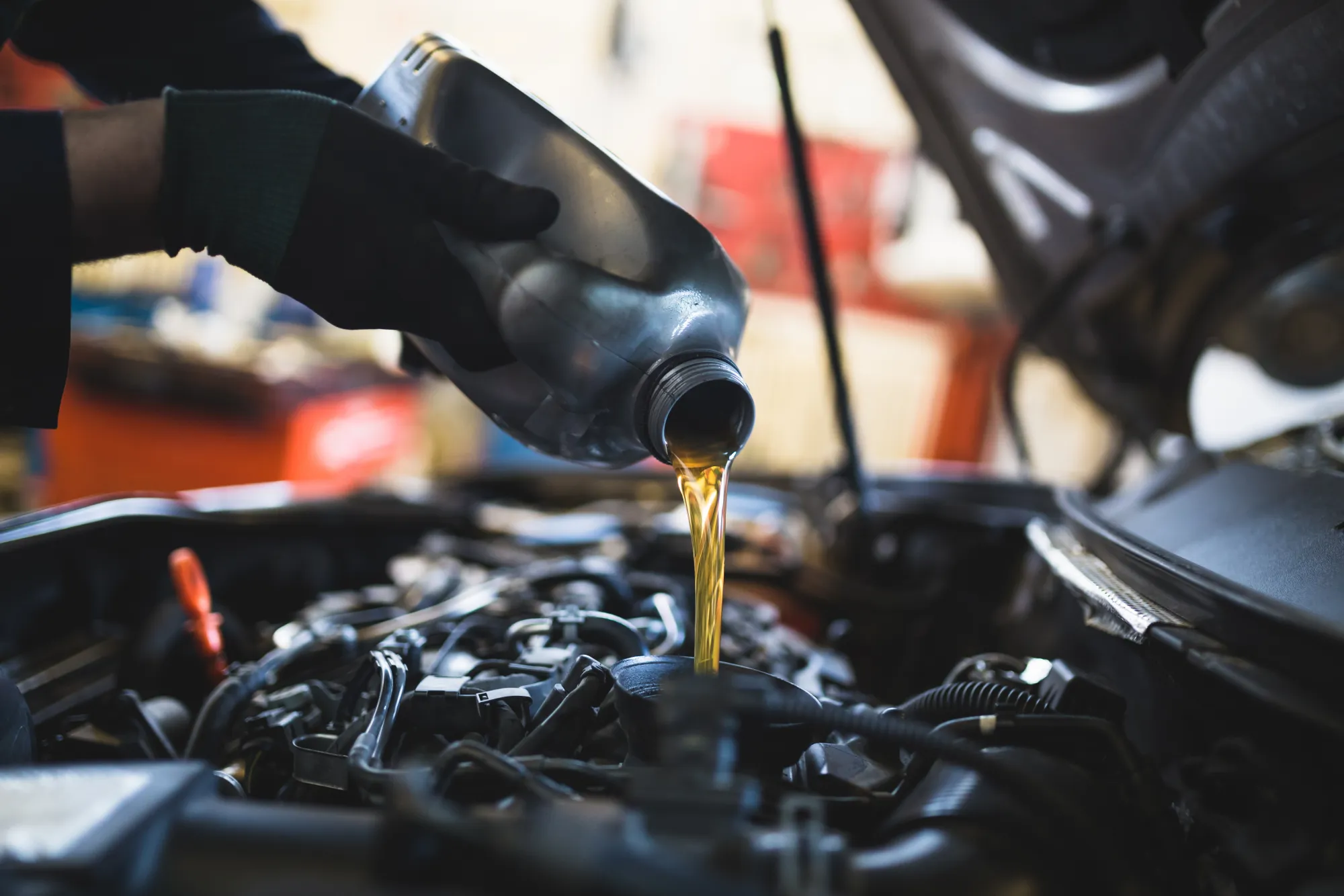
A turbo engine oil change is not a different procedure so much as a different standard of care. We confirm the approval the manufacturer actually specifies rather than defaulting to a shelf grade, and we fill to the correct capacity and verify it on the dipstick. West Tire & Auto Center has been taking care of drivers in Washington, Canonsburg, Houston, McMurray, Claysville and the rest of Washington County for more than 60 years, and turbocharged engines are a big share of what rolls through our bays now. Routine service, or full auto repair in Washington PA for a boosted engine that is misbehaving, gets the same approach.
Wondering what a turbo engine oil change or a carbon cleaning would run for your vehicle? It depends on your engine, its oil capacity, and the spec it requires, so request a current quote and we will give you a real answer for your car rather than a guess.