Anybody who drives around here knows the feeling. You come off a long ramp on I-70 or I-79, or you head down one of the grades toward the Monongahela River, and your right foot settles onto the brake pedal and just stays there the whole way down. It feels like the careful thing to do. It’s also the fastest way to cook a healthy set of brakes.
Washington sits at about 1,178 feet, and almost every direction out of town eventually drops toward a valley. Drivers running between Washington, Canonsburg, Charleroi and Monongahela spend far more time holding a vehicle back on a descent than drivers in flat country do. When brakes give up on a hill, it usually isn’t because the parts were worn out. It’s because they got too hot. That failure has a name, brake fade, and knowing how it works is the difference between reaching the bottom with a normal pedal and reaching it with almost no pedal at all.
Why Our Hills Are Hard on Brakes
A brake does one job. It takes the energy of a moving vehicle, turns it into heat, and sheds that heat into the passing air. On flat ground that works fine, because you brake for a few seconds at a light and then get minutes of cooling before the next stop.
A long descent breaks that arrangement. Gravity keeps feeding energy into the vehicle for the whole length of the grade, and if your foot never leaves the pedal, the brakes never get a cooling window. Heat goes in faster than it comes out, and it stacks up mile after mile. Around Washington County, with interstate ramps, river valley grades and back roads that fall away for a mile at a stretch, that isn’t an exotic situation. It’s Tuesday.
Which is why two people can drive the same hill in the same vehicle and walk away with completely different brakes. Nothing about the parts changed. Only the habit did.
What Brakes Actually Do With All That Energy
The numbers are more dramatic than most drivers expect. According to Continental, brake pads hover around 300 degrees Fahrenheit in normal driving and can easily reach or exceed 700 degrees Fahrenheit under heavy braking. ADVICS, the aftermarket arm of the Aisin group, puts everyday pad temperatures below 400 degrees and agrees that highs above 700 are reachable.
Those upper numbers matter because a pad has a temperature ceiling. Push past it and the resin holding the friction material together turns into gas. That gas forms a thin barrier between the pad and the rotor, and a barrier is the last thing you want between two surfaces that are supposed to be grabbing each other. Friction drops off, and so does your stopping power.
That loss is what the industry calls brake fade. Continental defines it as a reduction or total loss of braking capability due to overheating of some part of the braking system. Notice the phrasing. Some part. It isn’t always the pads.
Brake Fade Comes in Two Flavors, and They Feel Different
This is the part worth remembering, because what your foot feels tells a technician where to look.
Pad fade, also called friction fade. The pedal feels completely normal. Normal height, normal firmness, everything about it says the brakes are fine. The vehicle just doesn’t slow the way it should, and drivers describe pressing harder and harder for almost nothing back. That’s the gassing-off effect above, and it’s the most common form of fade.
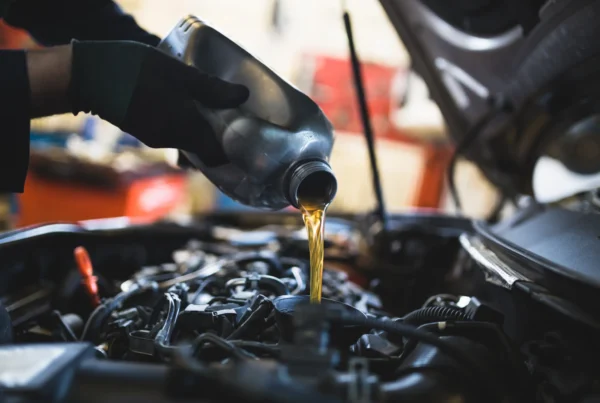
Fluid fade. Here the pedal itself changes. Brake fluid that gets hot enough starts to boil, the moisture in it flashes to vapor, and vapor compresses in a way that liquid does not. The result, as ADVICS describes it, is a pedal that goes spongy or drops straight to the floor.
Same root cause, two very different experiences, and both are dangerous on a grade with traffic waiting at the bottom. If you’ve ever felt either one, tell us exactly which it was when you bring the vehicle in. That’s real diagnostic information.
Why Old Brake Fluid Makes Everything Worse
Most drivers never think about brake fluid, which is a shame, because the condition of that fluid is part of how much heat your brake system can survive.
Federal Motor Vehicle Safety Standard 116 sets minimum boiling points for each grade. Fresh out of a sealed bottle, DOT 3 must boil no lower than 401 degrees Fahrenheit, DOT 4 no lower than 446, and DOT 5.1 no lower than 500.
Now look at the wet minimums in that same standard, the ones for fluid that has been in service soaking up moisture: 284 degrees Fahrenheit for DOT 3, 311 for DOT 4, and 356 for DOT 5.1.
That is a big gap. Brake fluid absorbs water over time, and as the moisture content rises the boiling point falls. Old fluid boils far sooner than fresh fluid, so an aging system can start fading on a hill that a freshly serviced system would handle without complaint. Nothing looks broken. The safety margin just quietly shrank.
That Hot-Brake Smell Is a Warning, Not a Quirk
There’s a sharp, acrid, faintly chemical smell that turns up at the bottom of a long hill, and plenty of drivers have learned to shrug at it. Don’t. A burning smell sits on Continental’s own list of brake fade warning signs, right alongside longer stopping distances, vibration, a soft pedal and discolored rotors.
What the smell means is simple. Your pads are at or past their working temperature, with no margin left for whatever the road asks next.
So get off the pedal. Let the vehicle roll if the road and the traffic allow it, because moving air is what actually cools a rotor. If you pull over, leave the parking brake off where it’s safe to do so, since a dragging parking brake holds hot pads against a hot rotor. Give it time before you start down another grade. And don’t test the brakes with one hard panic stop to see whether they still work. That only adds heat to a system already over its limit.
Gear Down Instead of Riding the Pedal
The technique comes straight from the people who take the heaviest vehicles down the steepest roads in the country. Commercial driver training is blunt about it: brakes can fade or fail from excessive heat caused by using them too much and not relying on the engine braking effect, and on a long or steep downgrade the brakes are only a supplement to the braking effect of the engine.
Read that again. The engine is supposed to be doing most of the holding. The brakes are the helper.
For a passenger car or a pickup on a Washington County hill, that turns into a few habits:
- Pick your gear at the top, not partway down. That same guidance says to shift into a low gear before starting down the grade, and warns against downshifting after speed has already built up. In an automatic, that means the manual mode, the low range, or the minus paddle before you crest the hill. In an EV or a hybrid, the strongest regenerative braking setting does much the same job.
- Brake in bites, not in one long drag. Press firmly enough to feel a definite slowdown, then release. The guidance for heavy vehicles is to come off the brakes once speed has dropped roughly five miles per hour below the safe speed, let it build back up, and repeat. Every release is a cooling window, which is exactly what a constant light drag never gives them.
- Pick a speed you can live with the whole way down. Fade comes from the total heat you put in, so a slower descent asks less of the brakes from the start.
None of this is hard, and none of it is slower in any way that matters. It’s just a different reflex than the one most of us default to.
A Load or a Trailer Multiplies Everything
Every bit of weight you add is more energy the brakes have to absorb on the same hill. As PowerStop puts it, brakes responsible for stopping more weight create more heat, which raises the chance of fade. The answer is the one above: drop into a lower gear so the engine helps hold the vehicle back, and apply and release firmly rather than riding the pedal.
For the tradespeople and truck owners around here, that’s the practical takeaway. A loaded bed, a landscaping trailer, a camper, or a full family with a packed cargo area all change the math on a grade you’ve driven a thousand times empty. Plenty of local drivers meet brake fade for the first time the week they start towing.
Tires belong in the same conversation. Whatever the brakes manage to do still has to reach the road through four contact patches, so tread depth and inflation are part of your stopping distance on a wet descent.
What a Technician Looks For on a Heat-Damaged Brake
Heat leaves evidence, and it’s often visible the moment a wheel comes off.
Glazed pads. Overheated friction material takes on a hard, shiny, almost polished look. A glazed pad has lost the texture it needs to grab, so it bites poorly even after it cools.
Discolored rotors. Blue or straw-colored patches on the rotor face are a heat signature. Those areas can also end up harder than the metal around them, which produces uneven grab, so a car that stops fine around town starts shuddering or pulling under a hard stop after a hot descent.
Grooves and thickness. Pennsylvania’s inspection rules put numbers on this. Under 67 Pa. Code section 175.80, a vehicle is rejected when drums or rotors are scored deeper than .015 inch, or when disc thickness measures less than the minimum stamped on the assembly or less than the manufacturer’s specification. Bonded linings under 2/32 inch at the thinnest point are a rejection too, as are riveted linings less than 1/32 inch above the rivet head.
Hydraulic evidence. That same regulation rejects leaking hoses or tubing, a leaking caliper, a leaking wheel cylinder and a leaking master cylinder. Heat is hard on seals, so a system that’s been cooked repeatedly is worth looking at closely, and a fluid spot on your driveway deserves an answer rather than a guess.
Here’s the part that surprises people. A vehicle can fail a Pennsylvania safety inspection on brakes not because the pads gradually wore out, but because heat cooked and scored the rotors past the thickness stamped right on them. The mileage looked fine. The hills and the habit did the damage.
One more thing on the repair side. New pads need a proper bed-in, and ADVICS recommends the 30-30-30 rule: thirty stops from thirty miles per hour with thirty seconds of cooling between them. Brand new pads can suffer green fade the first time they get really hot, which is one reason a set of pads deserves a shop that does the last step and not just the first.
When to Get Brake Service in Washington County, PA
Bring it in now if the pedal has ever gone long or soft on a descent, if the vehicle wouldn’t slow with the pedal down, if there’s vibration or pulling under a hard stop, or if you’re smelling hot brakes on a hill you drive regularly. Mention it at your next visit if the brakes only feel a little different than they used to, or if you can’t remember the last time the fluid was changed.
Brake service in Washington County PA is easiest to plan around the calendar: ahead of towing season, before a long trip, or before the first stretch of winter weather. A brake inspection then is a short visit that tells you where your margin actually is.
Every vehicle is different, and so is every brake job, which is why we’d rather look at yours than guess. Instead of a number that would be out of date by the time you read it, ask West Tire & Auto Center for a current quote on brake repair for your specific vehicle.
Brake Trouble on the Hills Around Washington, PA? Let’s Take a Look
If you’ve ever coasted into a parking lot and typed “brake repair Washington PA” into your phone, we’re the shop just down the road. West Tire & Auto Center has been keeping cars and trucks safe on Washington County roads for a long time, and brakes are a big part of that. If something has changed in how your vehicle stops, or you just want to know what your pads, rotors and fluid look like before the next long descent, we’ll get you in and tell you straight.